Book 3 in the Percy Jackson Series. Very enjoyable read. Another tale of bravery and following your heart to know what decision is best. Some parts were very predictable, others not. I again enjoyed more mythology.
SPOILER ALERT for discussions' sake
Percy finds out at the end from Athena what his fatal flaw is. Every hero has one. Well, I guess you could say every PERSON has one. The conversation between Athena and Percy brings something else to light. She says "Kronos knows your flaw, even if you do not. He knows how to study his enemies. Think Percy. How has he manipulated you?" And that mirrors common Christianity beliefs about the Devil, or Satan. He knows our weaknesses even if we don't. He knows how to study us and manipulate us into sinning. Athena then tells him "Your fatal flaw is personal loyalty, Percy. You do not know when to cut your losses. To save a friend, you would sacrifice the world." I can relate to that, as I have often described myself as loyal to a fault. Percy states "That's not a flaw. Just because I want to help my friends-" To which she replies "The most dangerous flaws are those which are good in moderation. Evil is easy to fight. Lack of wisdom...that is very hard indeed." SO incredibly true in life! Many people, if they are going to sin, won't be in the form of murdering someone or even overtly stealing something. It's going to be something else. It's going to be going overboard with "Wholesome Recreation" with your family, or taking care of yourself to be healthy to an extreme becoming obsessed with fitness and your body and extreme eating habits. Things that are good in moderation-and then taken to the extreme. Very dangerous territory indeed. Absolutely NOTHING is good in the extreme. Nothing.
Friday, August 23, 2013
Tuesday, August 20, 2013
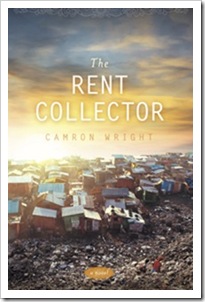
The Rent Collector, Camron Wright
This book was recommended by my friend Amy. I have a few friends who have such impeccable taste in literature that if I see they've read and liked something, I can pick it up without any reservations. This was one of those books.
It takes place in the actual Cambodian dump of Stung Meanchey. Several characters are real people, such as the main character Sang Ly, her husband Ki Lim and son Nisay. However, some of the book is factual and based on the author's son's documentary River of Victory (www.RiverOfVictory.com), but most is fictional. Based on the author's idea of what would happen if the people of Stung Meanchey were to be given the gift of literacy.
The Rent Collector, also nicknamed "The Cow" is an older woman who name is Sopeap Sin. Not many like her. But that all changes when Sang Ly realized that Sopeap knows how to read and requests to be taught. In Stung Meanchey, you earn enough for each day's food by going through the trash and picking out recyclables which you are then paid for. There really isn't a way to "get ahead" and even if you could, life wouldn't necessarily be better. For instance, when Sang Ly's son is continually sick and they have been to every doctor they can possibly take him to, she decides she must go back to the village of her childhood to the Healer who lives there. While waiting for the Healer to come back from a quick trip to a neighboring village, Ki is granted temporary work in the rice fields there. He makes less working the rice fields than he does at the dump.
I don't know much about Cambodia and the revolution there, but from what the book depicts it is every bit as awful as the Nazi regime. They killed anyone who was educated, claiming it was useless and selfish that the only ones who mattered were the working class. That it was unfair for anyone to live off the working class, therefore everyone had to work. Only those who worked would eat. But on the flip side, they stripped the identity of people in work camps stating that they were each only one grain of rice in a huge bowl. Take one grain out and the bowl is still full. That brings up a lot to think about in and of itself.
But Sopeap is not liked at all, it is not until she is needed again that you start to see who she really is as a person. It reminds us that the people who are the hardest to love are the ones who probably need it the most. It also shows how when we are sincere, sometimes we can break down the barriers and truly come to know the person inside a hardened exterior.
I absolutely loved all the references to wonderful literature, the discussions of what makes literature and how to interpret how everything is symbolic in literature as well as possible inclinations to the literal. There is a discussion about the Cambodian version of Cinderella, a woman by the name Sarann. And Sopeap details to Sang Ly that this story appears in almost every culture around the world, independent of one another. Sopeap talks about this idea saying "I am talking about the constant nature of truth. Look at Buggha's philosophy-it's about the path and our journey. That's what his teachings of the Noble Eightfold Path are all about. Do you see what I mean? Have you ever found a classical book of literature that isn't about a journey-whether actual or within?....There isn't one. It's not just Sarann and Cinderella. Look at all books, plays, movies-we keep writing the same plots, with the same characters, teaching the same lessons.Why do you suppose that is?" Sang Ly replies "Nobody has an original idea?" Sopeap replies "Or is the original idea so intrinsic, inherent, and ingenious, so fundamental to our existence, that we can't help but be drawn back? ... I'm suggesting that writers can't help themselves. Our trials, our troubles, our demons, our angels-we reenact them because these stories explain our lives. Literature's lessons repeat because they echo from deeper places. They touch a chord in our soul because they're notes we've already heard played. Plots repeat because, from the birth of man, they explore the reasons for our being. Stories tech us to not give up hope because there are times in our own journey when we mustn't give up hope. They teach endurance because in our lives we are meant to endure. They carry messages that are older than the words themselves, messages that reach beyond the page."
How beautiful is that? Instead of criticizing the fact that there may be only 7 plots in the world, why not explore WHY, at the core of human nature we seem to gravitate-heavily-to those 7 plots. It may have absolutely nothing to do with a lack of originality and EVERYTHING to do with the fact that people inherently want to hope, want to have freedoms, want to avoid things, want good to triumph over evil. Mind blowing! It's not a weakness. It is a strength to paint the same picture with different hues and different colors.
Anyhow, this was a truly beautiful story. So many gems of literature-I have decided that I highly prefer the Cambodian Cinderella Sarann to the one we know in Western culture-the entire tale is printed in this book! I even read it to my 8 year old. This book has not only taught me so much about kindness, patients and basic human needs-both physical and emotional-but how to appreciate literature on an even deeper level. Especially some of the older, classics that are not as sensational page turners but can teach us so much. I'm even inspired to go back and attempt Mobey Dick again.....we'll see how that goes! This book touched me and resonated in my soul. Now you read it!
Wednesday, August 7, 2013
Daja's Book, Tamora Pierce
I can't remember if I started blogging after I read the first two books in this Quartet....The first was Sandry's Book followed by Tris's Book.
Anyhow, these 4 younger kids (I can't remember what age they are at the start, maybe around 10-12?) are found by a renowned mage, Niko. They are brought to a place called Winding Circle in order to learn their magic and learn how to contain and control it. None of the kids new they had any magic within them before this. Sandry's magic is with weaving and the materials used to weave, cotton, silk, etc. Tris's is with weather. Before she learned to control her magic, a bad mood would bring storms and anger would bring lightning. Briar's is with plants and the earth. Daja's is with fire and smithing. Because their abilities are all rare, they are brought together in this small group for learning. They all come from different backgrounds too. Sandry is a noble by blood, Tris from a merchant family, Briar was a street urchin and Daja a Trader.
Daja was a lone survivor of her family's trader ship after a terrible storm and wreck. Because of trader beliefs, that is NOT good. If you are the only survivor, then you are bad luck, you are a trangshi which basically means that you are erased from the books of traders as if you don't exist. She is not allowed to live among traders at all for fear that her bad luck will bring ill fates to the rest of the caravan.
In this book, they have travelled with Sandry's uncle and teachers to a northern land that has been suffering from drought for 3 years, plagued by grass fires, and unable to even mine copper for which they are famous. Sandry's uncle, The Duke is seeing if there's anything he can do to help. The other mages are doing likewise. In a preivous book in order to survive a terrible earth quake, Sandry spun all of their magic's together and now they are finding that their powers are jumping from one to the other, which causes problems. For instance when Briar goes to feel the ground to know what's fully going on with the drying saffron plants-one of the two main forms of money for this community-lightning shoots from his fingers and it kills some of the plants and creates a piece of glass from the sandy soil. Sandry examines some gold thread and it melts. So Sandry has to weave a map of where things are overlapping and re-weave it so they don't interfere with each other anymore. Inadvertently, Daja creates a living iron vine that actually grows and sprouts limbs and buds-so does so when it gets more metal to draw from. The Traders want this item, but according to their law, they can't do business with a trangshi. However, this is such a valuable and unusual item....things might change.
I really like these books, set in alternate times (I think older times for this one), a little like Harry Potter in which some people have magic and some don't, and you have to learn to use it. But unlike it in that you really specialize based on what you have and it's tied to certain elements. And not as sensational. Everyone knows about people with magic and rely on them to help out with their abilities, as Yarrun whose job it is to put out fires. It's nice to see kids from so strikingly different backgrounds become friends and how their backgrounds help give different perspectives on things. And how people can grow to become your family.
These are quick read books and very well written with many noble traits valued, such as honesty and integrity, not being greedy and doing things for the right reason. Being patient and understanding, even when you don't like the other person or how they act. All sorts of characteristics that every parent would want their kids to have. So having many protagonists value those traits makes these great books for a young reader to put on their list as well!
Saturday, July 20, 2013
Gregor and the Code of Claw, Suzanne Collins
The final book in the Underland Chronicles. In some ways I liked it a lot and in others, I didn't.
Gregor's mother has had a relapse of sickness from the plague in the form of pneumonia. The war that Luxa declared is in full swing. Everything hangs on the thread of the Prophecy of Time and the Code of Claw. The Code of Claw is the secret code made of taps, clicks and scratches-not too unlike Morse Code-in order to transmit information. The rats have made a new code and in order to receive the intelligence of their movings and strategies, they must crack the code. The prophecy calls for the "Princess" to help. Boots is less than helpful with the code team as all she does is sing and use strips of code as a "tail." Everything changes when suddenly Lizzie turns up on the scene. Their father has had a relapse of sickness and their grandma is sick in the hospital. She wants Gregor to come home, but also agrees upon seeing the plight of the Regalian's that his-and her own-help is needed. Lizzie who is so smart and loves to work on math and puzzles is enlisted to help break the code.
The romance between Luxa and Gregor blossoms. Which I thought was rather ridiculous. I mean, these kids are 12. I know they've been through a LOT to make them grow up faster than any kid should have to. Luxa facing the reality of leading her people as a queen at age 12 and Gregor being a key player in the war as a warrior at age 12. But seriously, they even kiss in this book. I don't want to think of a 12 year old kissing. And they say "I love you" which is true because I'm sure they love each other as friends and beyond that is just a crush. To think that 12 year olds are capable of knowing what real romantic love is before their hormones are even fully there yet, despite their particular circumstances, just seems like a bit of a stretch.
The other part I didn't care for is the obvious blatant anti-war agenda and anti-Christopher Columbus agenda, and even a bit of anti-early America agenda. Yes, I do understand that war is bad. And she does point out that it would take EVERYONE in the world rejecting that war is an acceptable way to settle differences. But as long as there are still groups of people bent on killing as a means to their end, we must accept that war in defense of our freedom is inevitable. We do not have to like it, but unless we are willing to sit and die and watch everyone else die because others do not agree with a philosophy of not fighting, we don't really have options. Of course, things get a lot more complicated when you have to consider whether or not you get involved with a conflict outside of your immediate country's safety and have to consider allies and helping them etc. But I'm not going to into that. Anti-Christopher Columbus. Yes. I realize he was not a good person, really. He discovered this land-and don't tell me he didn't because it was new to HIM and it was new to all the OTHER people who weren't aware of its existence. I just discovered a new way to avoid the construction and get to the grocery store with less hassel. It was MY discovery. Sure, it existed before I knew about it and many other people have been using it before me, but it doesn't discount that I found out about it without anyone else telling me it was there. And he didn't treat the natives well. And the fact that Spain just hoped he would be killed in the process of finding this land so they wouldn't have to deal with him (most likely) doesn't help his case either. But you can't decide that he didn't do something incredible just because he wasn't a good person. You have to separate that. You can't just re-write history because he was bad. Good or bad, what he did was what he did. And you shouldn't try to teach that we shouldn't celebrate Columbus day because he was bad. You can lay out the facts and let people decide for themselves their view of him. But he wasn't the only person on the ship. There were other people on other ships as well who WEREN'T bad people who probably DIDN'T agree with all of Columbus' decisions, but we don't know about them. And I admit it's a shame that we know very little about those other people. And the anti-early America agenda. I couldn't help making connections between what early European settlers and the American government did to Native Americans and the things that Sandwhich and the early Regalian's did to other species in the Underland in order to take possession of the land they wanted. Including the poisoning of water sources. And then the references to the plague being used as a weapon. Which reminded me of the Native American's being given a "gift" of blankets that just also happened to be infested with small pox. I'm not saying any of this was RIGHT. It was downright REPULSIVE. But we don't do that anymore. Well, at least as so far as our government lets on.....I'm just saying the attitude it was portrayed in wasn't conducive to what I think she wanted to accomplish. You need to accept that mistakes were made, and it's a shame that they did, but that the best way to show you believe that is to make an individual change. Don't condemn our nation because of some really bad mistakes. Is Germany forever condemned as a nation because of the Holocaust? Do all of Germany's citizens walk around with their heads hanging because of how ashamed they were that Hitler duped them all into becoming a horror symbol to the world of some of the most heinous crimes against humanity AND the most RECENT horrific offenses in world history of that magnitude? I don't think so. I mean, I've never been to Germany, but I've had several friends live there for varying durations from 18-24 months and that's not the scene they paint of the people of Germany. They acknowledge and they say that they regret it happened. That they wish they could change the past, but they can't, so instead they are looking to build a better future to ensure they are never sweet talked by another leader again or allow such crimes to repeat themselves. At least not on their watch.
The character of Mrs. Cormaci makes a comment about war and how we're brought up to treat others kindly and to hurt someone is a crime and then you become a soldier and shipped out and told to kill and how that has to do something to you. It does. But I think the soldiers who are most resilient are the ones who know exactly what and who they are fighting for. They are fighting for the freedoms they want and the for the people they love. They never get to the point where they ENJOY what they do, but they realize that in order to prevent extreme suffering, they must do what they must do.
There was even a touch on "pupettering" I don't know how to spell the term correctly, but when there is a person who is the leader, but not the mastermind. Some wonder if Hitler was the mastermind behind the Holocaust or if it was really one of his advisors who used flattery and manipulation because he couldn't rally the people the way Hitler could. The Bane is really only the leader of the rats because of the coincidence of his color and size in relation to the Prophecy of Bane, and because of how Twirltongue flatters and manipulates him to believe certain things. But Twirltongue knows she could never BE the leader. So she simply controls the leader with her agenda.
Anyway, despite all of that going on....and my daughter and I read this one out loud to each other, and she didn't pick up on most of this, and a few things I pointed out and we discussed how we felt about it and how it plays into our Christian value system and when war is ok and when it is not, etc. and when God sanctions an act that is a "thou shalt not" in the commandments. So it did open up some good dialog, even if it was a bit annoying in its blatancy.
The other thing I couldn't quite figure out if there was an agenda to it or not was the Prophecy's. Ripred admits to Gregor that he doesn't-and has never-believed in the prophecy's written by Sandwhich that if you stayed long enough, any number of things could be made to fit into it. And if something looks like it's going along and then changes, they say they must not have fully understood it. Also, it brings up the power of suggestion-did people do things in the prophesy because it suggested they should? Or would it have happened regardless? They've had to re-interpret things to fit what was written before, and chalked it up to lack of understanding. Ripred has used it to his advantage, but has manipulated it too in order to accomplish a task at hand. I don't know if this was a stab at religion or not, because Sandwhich was not a religious figure, and therefore, we have no idea where his "authority" to even make prophecy's would be. Although I guess a prophecy doesn't need to be religious in nature, although when it's not I've usually seen it referenced as something else, like predictions or foreseeing. I think the word prophecy denotes that it came from a prophet, which is a religious figure. Anyhow, giving something the title of prophecy makes it sound more serious, more legitimate, and more weighty and therefore have more power over the mind.
I'm not entirely sure I like where things ended, but when you go on a journey with characters, the story has to end somewhere and you will always be left wondering what happened to them after, but this series left with more questions unanswered than others. Even Hunger Games at least let you know what happened with key players-whether you liked it was a different story-and Harry Potter had a great epilogue. Here, Gregor's family still doesn't know what they are going to do, Regalia has a brighter future than ever, but you still wonder if it can be pulled off, and how.
There were still twists and turns and very unexpected things that kept you hanging on the brink. I would still recommend this series, but I would also highly recommend that if your child is reading them, that you read them as well and have some really great conversations with them.
Monday, July 15, 2013
The Testing, Joelle Charbonneau
This is the book selection for my book club in August. Another fairly quick read at 325 pages and a teaser of Chapter 1 of the 2nd book. No, I did not know this was a series when I picked it up.
Very reminiscent of The Hunger Games but with a twist that makes it slightly more believable. Malencia (Cia) Vale lives in the Five Lakes Colony (formerly the Great Lakes) which is probably one of the smallest Colonies that make up the United Commonwealth. After the 7 Stages of War-the first Four of which man attacked man with all manner of a physical and biological weaponry, and the last Three in which many of the man made attacks triggered the Earth to "retaliate" with subsequent earthquakes, wind storms, tornadoes, etc. leaving the Earth largely barron between biologically engineered toxins and poisons to radiation. Many animals, plants and even some humans who were able to survive the radiation were permanently altered genetically. Perhaps a small field mouse now has claws and teeth that are now venomous and has no fear of people and would attack a person with no provocation. New biology engineering must happen in order to breed new crops resilient in nutrient sparse soil and to increase the nutrients in the soil as well. Much technology was lost, though I don't think as much as they let on.
In order to get the best and brightest in the areas of studies needed most to revitalize the land, the people and the government, some of the top students of each graduating class in each colony are invited to the capitol, Tosu City (I never quite figured out exactly where that was, although many other landmarks were mentioned, I didn't pay enough attention to pinpoint it) where they have been selected to be Tested in order to see if they will qualify to continue on past what we would consider a high school education. Anyone who is not selected will enter into adulthood (at around 16 or 17 years old) and pursue a career path that will help their colony thrive. Successful Testing candidates will attend the University where their strengths will be evaluated and will be placed in the area of study they are best suited for and has the most need of their unique skills. They are the future leaders of the country.
Cia has always dreamed of being a Testing Candidate. It is considered an honor to be chosen, and your family even is granted a monetary stipend for not having you there to contribute anymore. Her father was a testing candidate, but no one has been chosen for Testing in the Five Lakes Colony for 10 years. No one knows exactly why, but with only around 900 citizens or so, it's largely assumed that Tosu City officials determining that Five Lakes can't afford to send any of its citizens away.
Then Cia gets chosen. That's not really a spoiler alert. Due to the title and main character, it's rather obvious that she's going to be there. But what happens when she gets there is what is going to horrify you. There are 5 stages of testing. 1 the written component. 2 the hands on component. 3 the teamwork/group component. 4 the practical application. 5 the interview. From a start of 187 testing candidates, 20 will enter the University. How on Earth do you narrow down 187 to 20? That's what no one knows. The 20 who make it have absolutely no recollection of the testing process-which is to ensure confidentiality so that no future testing candidates will have an edge over anyone else.
You will come to really like Cia. I didn't get as emotionally attached to her as I did Katniss, but she certainly is likable There's a little bit of a romance, a seeming attempt from another character to get a triangle going, but it never surfaces. Like Divergent, you are not quite sure who you trust. And Cia's father has said "trust no one".
So think Hunger Games type brutality, except NO ONE KNOWS what's going on except for Testing Officials and obviously the government. NO ONE suspects a thing. It isn't an overt lesson year after year proving the government's power by forcing you to watch children you know fight to the death. Families know that once you go to Tosu for the testing, you will probably never return home because you will be reassigned to another colony where your skills are needed. And because of the lack of ability to communicate long distances from the loss of technology, there's really no reason to believe that a lack of contact means anything else.
That's what makes it a bit more believable. If any 1st world country were to do anything shady, they sure as heck are not going to broadcast it across screens and parade it in front of the world. If anything seriously wrong is happening, it's going to be well hidden and drenched in secrecy. A wolf in sheep's clothing of biggest proportions.
I am anxious for book 2 which comes out this fall "Independent Study" if for no other reason than I want to see if Cia will succeed to have her upbringing and personal moral compass find a way to combat this secretive government to take all the good and leave the bad.
One of the biggest discussions from this book is "What makes a good leader?" There are references to needing to know when to fight and when to talk, how one of the faults of the last American President was that he was not willing to fight but attempted to talk it out with other countries bent on killing (ironically it was the Middle Eastern Coalition who first take out Washington DC and Boston followed by the Asian Alliance taking out Chicago). There's also discussion on how a leader should trust or not trust other people and how to tell who they should trust-and how to trust their own instincts and their own gut. And a good leader must know when to stop. A good leader would make mistakes-because we all do-but what separates a good leader from a bad one is that a good one would learn from those mistakes and never repeat them. They would admit to making a mistake and go in a different direction-no matter what it took or what others thought of them. They would do the right thing-to the best of their knowledge-with little regard to "popularity". The book doesn't come out and state that last one, but I felt it was heavily implied, since Cia makes a lot of choices that she thinks are making her look weak but when someone else talks to her about it she realizes the perception of others saw strength. And as chapter 1 of the second book in the sneak peak says "Thinking something is true doesn't make it so. Perceptions is almost as important as reality." and a good leader would know how to use both to their advantage.
Wednesday, July 10, 2013
The Compound, S.A. Bodeen
Bodeen's first novel. It's a super quick read (I read it in two days and I'm a mom-that says something!) at 250-some odd pages.
It's the story of Yanakakis family. Wealthiest software developer who lives in Seattle. He has an adopted oldest daughter, Lexie, and twin sons Eddy and Eli, and a younger girl, Terese. Rex Yanakakis also has an obession. It's about nuclear war. He knows all the dates of everything having to do with nuclear war-and he's prepared too-with an underground compound built to withstand a nuclear winter of 15 years. The family knows about the compound, but never truly expected to see it. Until the fateful night when it all becomes real, and their father rushes them to the compound.
The story is told from Eli's perspective. He is 9 when they enter the compound, but then narration skips 6 years ahead in time with the occasional flashback to fill in gaps both from the previous 6 years inside the compound as well as to life before they had fled to their underground home.
I would probably give this book 3-3.5 out of 5 stars. It's highly predictable, and a little twisted in places. Twisted as in "that's SO wrong on SO many levels." But it is an interesting concept. What will people do in order to survive? What do you do if you're trapped in a situation where the authority figure is excessively controlling? How does having money affect the motives of other people in your life? Why do some people cave in their personal moral beliefs in the presence of someone with power and authority? For instance, there is a flashback in which Rex is throwing his Christmas Eve party and probably half of the guests are vegetarian or vegan-and he knows it. But he insists that everyone take a place with a serving of meat on it. And then, to further test the limits of his power, he then goes around the room and talks with each guest individually and asks them if they've tried the meat. If they haven't, he insists on them having one bite. And stays and watches while they do. Now, I know it's far fetched for a vegan or strict vegetarian to cave (have you ever met a vegan who didn't completely EXUDE the fact that they WILL not, under ANY circumstance consume an animal product?), but the example is that people who are not completely and wholly committed to their cause or belief system will cave in the presence of an outside pressure. And I think that that part is a valuable lesson for young people. I think it was Gordon B. Hinckley, former President of the Church of Jesus Christ of Latter-Day Saints who was infamous for saying "If you don't stand for something, you'll fall for anything." So whatever it is you choose to value and believe, you need to commit to it 100% so that when the Rex Yanankakis's of the world insist that you eat that bite of meat, you can say "I'm sorry, but I don't __________" and if pressure continues, to just politely excuse yourself completely from the situation-no matter what the repercussions might be in your life.
Will Eli make that choice?
Saturday, June 15, 2013
Gregor and the Marks of Secret, Suzanne Collins
Book 4 in the Underland Chronicles. Man, I am going through these so fast! They are all around 300 pages and super easy quick reads. Book 5 is now waiting to be picked up at the library, and it's the final book. So sad!
In Book 3, a new character, Hazard, is brought in. He's 6 turning 7 and turns 7 at the beginning of this book. His father was an Underlander who ran away from Regalia. His mother was an Overlander whom we know next to nothing about, except that she was killed when Hazard was young. Hazard has a unique talent in that when he was super young, he learned how to communicate with the Hissers (lizards) and other various jungle dwelling creatures. He and Boots start learning how to speak "Crawler" language too (Cockroach). This multi-lingual ability serves the group well in many instances. Which goes to show you that when you learn to communicate with others and make the effort, especially to communicate in their native tongue, it goes a long way. I think this has something to do with the anti-war agenda because many Americans believe that everyone should learn OUR language and not the other way around. And so in many, MANY nations, English is a required second language course. But that is quite arrogant of us, isn't it? Now, I feel pretty strongly that if you want to LIVE in America, you need to learn English. Just as I would feel it absolutely necessary for me to learn Korean if I were to personally choose to go live in Korea. Or learn Swedish if I were to choose to live in Sweden. I would expect my children to be held back a grade in school if they didn't master the language to their grade level ability by the end of the year. Because it's different when you choose where you live. In my mind. And that's just my opinion. But when it's about communicating, you should make an effort to do so in the language of the people you're communicating with. And if the other person showed you the same courtesy, a mixture of two languages and mutual respect and appreciation for the effort can't hurt either one.
Anyhow, in this book, the nibblers (mice) are the ones in trouble, but also an entire war is about to break out between the gnawers (rats) and the humans (whom in the old old language are referred to by the rest of the underland as killers). In fact, this is the only book that ends in a true cliff hanger and will segue into the final book.
I look forward to see how it wraps up!
Subscribe to:
Posts (Atom)