Sunday, June 24, 2012

Crossed, Ally Condie

This is the sequel to "Matched". It was also really good. Ironically the same exact number of pages. Split narrative between Ky and Cassia (which I saw on a short interview with the author is pronounced Cash-uh) every other chapter. It read faster than the first. A little more action, though not a ton. More into the depth of the Society. And a better look into the Rising (or rebellion).

**WARNING*** IF YOU HAVEN'T READ THE HUNGER GAMES SERIES, THE REFERENCES I USE IN THE NEXT PARAGRAPH ARE SPOILERS ABOUT ONE ASPECT

"Crossed" leaves you hanging the way "Catching Fire" does in the "Hunger Games" series, where you find out that District 13 does indeed exist and it's thriving well. Having experienced "The Hunger Games", and with Ky not trusting of the Rising (he doesn't trust ANYONE to be honest), I too am skeptical. Is the Rising just another version of the Society? A horse of a different color the way District 13 turned out to be.

But unlike the "Hunger Games", there is a third group of people in the "Matched" trilogy. The farmers. Not part of the Society and never have been, but not part of the Rising either. They just want to live their lives to the best they can and be left alone. It will be interesting to see what role, if any, they play in the last installment.

Although not nearly as emotionally charged as "The Hunger Games", it still poses great questions about governments who are controlling. Many people accepted such a Society so that they could eradicate disease and cancer and other conditions. They accepted that the Society would make decisions with their best interest at heart. However, in doing so, they gave up their freedom of choice. And who's to say that EVERY decision they make truly IS in everyone's best interest. Sure they could guarantee a wonderful quality of life until the age of 80, but that is when the Society decides that your life must end. So that you can also be guaranteed to die with family close because no one should have to die alone. It's better than dying at an unknown time.....or so they want you to think.

If you're looking for something full of action and suspense like "The Hunger Games", you might be disappointed. If you're looking for another view of a controlling Society that rips freedoms away from the people slowly and surely with a philanthropic sheep's clothing as a warning not to let that happen to YOUR country, then you will not be disappointed.

For those who are opposed to the violence of "The Hunger Games", this is for you (although I have my own personal opinions about the necessity of the violence portrayed as a vital learning tool-it's  not as if the Nazi's were exactly philanthropic just because they did the killing themselves instead of pitting the children against each other...). I feel it should be required reading for middle or high school, probably high school, so that discussions about politics and the role of government can be discussed as well as moral issues-such as the arranged marriage debate.

And the burning question posed on the back of the books: Can there be freedom without choice?

Count down to the third and final book "Reached" Is due out on Nov. 13

Friday, June 15, 2012

Matched, Ally Condie

Another dystopian love story. Why are we as a society so......obsessed? Or is it morbid curiosity? And WHY WHY WHY can the thousands or so readers realize that these types of things COULD happen to US if we are not CAREFUL about what we allow our law makers to do???

This was such a great read. It was like Farenheit 451, The Giver, 1984, The Hunger Games all rolled into one new perspective. The one in which the Society is not openly oppressive; well, I take that back, Cassia, the main character and narrator, lives in the City, which could be sort of like the equivalent of the Capitol from the Hunger Games. Where they have it so good, they don't know what the Society is really like. But in other ways, it's nothing at all like the Capitol. Or what we know of the Capitol anyway.

In this Society, all the choices are made for you, because the Society knows best. Based on good solid data and evidence from studies. Everything is predictable. Statistics are reliable. And when everyone follows these things like blind sheep, everyone can live a happy, 'fulfilled' life. Free of danger, free of pain, free of sickness. All you have to do is surrender......true freedom.

With the exception of Farenheit 541 and The Giver, I have read the other books within the past few years. The former I read in high school and I can still remember a LOT of it. How it made me feel. The impression it had on me. The latter I read in the 6th grade and it simply creeped me out at that age. I suppose I should read it again as an adult, but part of me is still creeped out. I don't think I knew enough about society and agency etc. enough to really appreciate it then.

Anyhow, there are common threads in which a government maintains control that I've noticed throughout all this type of literature.
1) Isolation-from other parts under the same rule. If you can't communicate, you can't orchestrate an uprising, therefore, the government can ALWAYS be bigger than its potential rebellions. United we stand, divided we fall. Requiring everyone to only know what they need to know for the good of the Society and not one iota more-and being expected that no one else needs to know what you do either, and expected that you wouldn't ask anyone personal details either-isolates people on a personal level.
2) Imitation-relationships that are fabricated so well they seem real. Being "Matched" to your "Perfect in every way for you" mate, 'applying' for children, being regulated on how many children you can have-in some societies, not even being allowed to be biological parents. Not being allowed to have romantic relationships at all. All of this also can fall under isolation as well.
3) Food Control-when the basic need of food and water are regulated, the fear of starving to death is a strong deterrant
4) Guilt for Ambition-that if you want something for yourself, you are obviously selfish for wanting it. Like Cassia once says "Who am I to try to change things, to get greedy and want more? If our Society changes and things are different, who am I to tell the girl who would have enjoyed the safe protected life that now she has to have choice and danger because of me?" And how people would just disappear if they started to think to much, know too much, be too ambitious even in doing their own job- like in 1984.
5) Reduction of knowledge-in 1984 there's is the only society in which the dictionary gets smaller every year. In Matched, there were committees that selected the One Hundred this and that-songs, poems, history lessons, books, etc. claiming that things were getting too cluttered. That having access to more than that is simply overwhelming to the human brain. When really it is just too strongly empowering and inspiring to allow into the public's grasp. Knowledge IS power. Just look at what the knowledge of things does for people!
6) A means to tamper with private lives-"Big brother is watching you" whether it's through ports, two way televisions (which by the way exist now and have brought up the possibility of privacy infringements), bugs, dream monitoring, personal surveillance, curfews, inhibitory drugs that suppress normal human appetites (The Giver), or memory (Matched with pills, 1984 with torture), etc.
7) The control over media (if it exists) and/or communication-In 1984, the main character's vocation is to be a 'fact checker' and make sure that the news of today matches the predictions the government made yesterday. He goes back in the archives to find the old predictions and if they are not congruous, he changes it and rewrites it so the government is always right. The contradictory original is incinerated. Leaving no evidence. They also erase the existence of people if necessary. In Matched, the Society controls what is played in the music halls and movie theaters. In the Hunger Games, all are forced to watch the games. In Matched, when things don't go the way they planned or anticipated, they try to cover it up, twisting and turning the truth to make it seem like they were in control all along. To make people second guess themselves. To try to put more trust and faith in their system. They only show one side to every story, and that is the one in which their system is the only one that ensures the good for everyone.

I most recently read the Hunger Games triology and while at first they seem completely opposite with each other, having one government rule with fear and violence and the other by coddling and 'caring' for its citizens, they really are more similar deep down. It was great to look at it from this angle in Matched. That a government doesn't have to be scary or force horrible violence, starvation. Sometimes just letting the government TAKE CARE OF US is enough to hand over enough power. Sure, I don't want the burden of having to do that, oh, YOU'LL take care of that? Sure, thanks! And slowly we are lazy and don't want to make any decision making for ourselves. Slowly we've turned over all our freedom to choose to someone who will do it for us. We trust in some unknown entity that we will be protected, fed, clothed, given a job to feel purposeful and fulfilled in our life, give us a mate we are guaranteed to be compatible with, even give us the gracious allowance to have families if we choose, eradicate disease to prove they have our best interests at heart. The promise of feeling minimal if any pain at all. Being safe. But what's the cost? This Society is the wolf in sheep's clothing. Benign to most-unless something happens to make you think otherwise-and most of the time it's not worth the high stakes of pursuing a doubt.

It's been said that democracy can only work in a society that WANTS it. And you have to want it bad enough that you are willing to take the bad along with the good. That you are willing to preserve it when it is threatened. Even if that means you have to fight physically for it. Even if it means you have to die for it.

Another quote I remember goes something like this: "Even if you choose not to decide, you have still made a choice." If YOU aren't going to decided, who do you want to do it for you? And even if you were to trust a person, or body of persons now with those decisions, will you ALWAYS have trust in that person or persons? What happens if the person/s change? Personal freedom of choice-for good or bad-is the only way a nation can preserve true freedom. This means that we chance being hurt-emotionally or physically. This means that there is no guarantees. But how could we truly know the sweet, without knowing bitter? Is freedom to make your own choices and live the way you want (within reason) worth this to you?

Sunday, June 10, 2012

The Sweetness at the Bottom of the Pie, Alan Bradley

I am hooked. The narrator is 11 year old Flavia de Luce, the youngest of 3 girls living with their widowed father. Flavia is an interesting cat enthralled with chemistry (which I LOVE! I absolutely adore chemistry) and particularly poison. When she stumbles upon a corpse in the cucumber patch outside her window early one morning, she determines that she will get to the bottom of it all.

Don't be fooled. She's not Nancy Drew. She is refreshing and intelligent, sometimes impertinent. I'm having fun coming up with my own conclusions and am anxious to find out if any of them are right or not!

Update: I loved the ending! Some of my hunches were in the right directions, and others couldn't be further from the truth. Oh, and I love the sibling rivalry subplot too. I found out there's a sequal! 

Wednesday, May 2, 2012

You'll Lose the Baby Weight (and OTHER LIES about pregnancy and childbirth) Dawn Meehan

My friend found this book at a dollar store. Let me tell you, that was one dollar worth spending! I could NOT stop laughing. It's not a medical guide or anything, but a humorous approach to everything pleasant and not about being pregnant and giving birth. Tongue in cheek, first thoughts crossed out in a *coughAHEMcough* style with snarky comments make this one of the funniest books EVER. Even my husband laughed at her rendition of a Pap Smear test. "If you want to lighten the mood while your doctor is performing this exam, as her stuff like. 'I lost my car keys yesterday. Can you see if they're in there?' Or maybe 'Hey, could you show that Q-tip up any farther? Are you trying to clean out my ears with that thing?' Or, it's always fun to throw them off with crazy, obscure small talk like 'So, if you had a pet hippo, what would you name him?' Or 'How many candy canes do you think you could fit in your mouth at once?' Hey, you gotta do what you gotta do to get through these awkward exams, right?"

This is so funny-but also talks about things that no one ever told me about pregnancy/childbirth and after childbirth, in a humorous approach. I thought this book was so great that I'm seriously thinking about hitting up that dollar store for several copies to give to friends-especially those who are pregnant for the first time. Just to lighten up the mood from all the information you feel the need to absorb. Read it.

Saturday, April 28, 2012

The Good Earth, Pearl S Buck

I believe this was my first book by Pearl S. Buck that I've read, except for maybe a short story here or there in high school. Her writing style was nice and I could feel the cultural implications very well, although the narrator, Wang Lung is a Chinese male, neither of which describe the author. I guess this posed some controversy back in the day, but it didn't bother me.

This novel starts with Wang Lung as the young man son of a widowed farmer, the only surviving child of his father. They have a farm and he respects the land, loves the land and lives by the land. It follows this man, Wang Lung through trial and error, friendship and betrayal, feast and famine, rags and riches through his life until upon his death bed. I have very mixed feelings about aspects of the story, but it is only because I don't like the way women were once viewed and treated-and still are in some places today. That any female child born was automatically called a "slave" because all she would be good for is either being sold as a slave, sold to prostitution, or to become a wife and bear sons. Wang Lung has moments where he would defy the cultural expectations, for he does have a good heart, but he also falls victim to pride of how things "should be" and that angered me even though I fully understand it within the cultural and time period frame work. It outlines what my religion has dubbed the "pride cycle". Those who work hard to rise above their estate and have good fortune sometimes forget their times of hardship, and most importantly do not pass on this insight to their posterity. And so things come full circle. History when forgotten repeats itself. My favorite character of this book is Wang Lung's faithful wife, O-Lan. Many moments of incredulity were over the merits of her character, but she was far from perfect, but given her upbringing, she turned out remarkably well. Only one act of hers I find extremely hard to forgive, again, though, understandable in context, still broke my heart.

I couldn't put this book down. It wasn't a heart pounding page turning type pull, but a "what will he possibly do next?" pull. This is the first book in awhile that I've read within two weeks time.

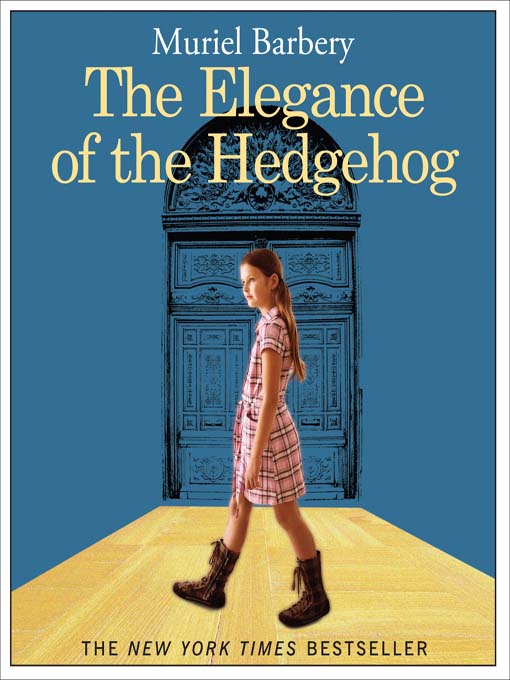
The Elegance of the Hedgehog by Muriel Barbery

This is a French novel translated into English. With that being said, it is VERY French. And I liked that. I enjoyed this book far more than I expected. It is a split narrative between 12 year old Paloma and 54 year old Renee. The most refreshing thing I found technically was the different fonts used for each author. There was no mistaking who was talking and that made the mental adjustment between the two narrators completely seamless. Why has no one thought to do this before??

Anyhow, Renee is a concierge at a very expensive apartment complex in which each floor is its own 4000 square foot apartment, of which Paloma lives on one floor. Both are rather ignorant of each other for a majority of the story until a new tenant, Mr. Ozu makes his entrance.

Paloma you find out in the first chapter is suicidal, but not for the reasons one would expect. She is very intellectual and has many great insights, but being only 12, really does need some expansion of the knowledge she has to turn into wisdom, and so in that respect it is a coming of age story for her.

Renee is a complex character who is easy to love but sometimes hard to understand. She has inner fears that even she is not comfortable discussing with the reader for a long time.

Full of expected and unexpected exchanges, humor, pessimism, optimism, hope, joy and sadness, it is a great book full of things to think about. Oh, and just so you know, with two intellectuals narrating, the vocabulary used is tremendous. You can usually gain meaning through context, but I chose to use my dictionary app on my phone to make sure I had full understanding and I learned quite a few new terms....but don't let it deter you from reading this great story!

I found out that a movie was made in 2009 of this book, and it is available with English subtitles. I am anxious to see if my library can get a hold of it so I can watch it!

Thursday, April 12, 2012

The Girl Who Was On Fire, Edited by Leah Wilson

This was an AWESOME read! For many of the sections, it was affirmation that I wasn't the only one viewing the books in a certain light ("for me the romance was a subplot" and a consistent comparison to George Orwell's "1984") and others while I don't see it the same way, I can respect their perspective and take from it what I will (which also made me think of things in a different way). And some introduced ideas that I had never entertained (the idea of "community" being a vital part of freedom). Since writing much more would be spoiling your read, I'll just leave the titles of each chapter/section-maybe a tidbit-but not more. This is DEFINITELY worth your time! Especially for those who may have viewed the Hunger Games triology as being a bunch of violent killing, it will help shed light on the more important message-that we know it was wrong and the citizens of Panem knew it was wrong, but many just didn't know how to go about stopping it. So here's the table of contents:

Why So Hungry for the Hunger Games?
Team Katniss
Your Heart is a Weapon the Size of Your Fist (love conquers all, right? But love of WHAT exactly?)
Smoke and Mirrors
Someone to Watch Over Me (Some of our most popular TV shows are a bit like the Hunger Games. Sure, nobody dies on our reality TV shows. But we still watch people suffer. We watch them endure physical and mental challenges on Survivor, subject them to isolation on Big Brother, tell them their dreams will never come true on Idol, and break their hearts on The Bachelorette. Reality TV is all about putting people in difficult situations and watching how they react. Some people come out stronger, richer, and healthier, facing a lifetime of success. Others are voted off the island early on, their failure broadcast all over the world. How many steps are there, between our own TV shows and the Hunger Games?)
Reality Hunger
Panem et Circenses (how a society can, will, and does trade political responsibility and therefore power in return for food and entertainment)
Not So Weird Science (did you know that scientists created a sheep/human hybrid? Mostly sheep with only a few specks of human DNA, but STILL! Its name is Polly, created shortly after the first successfully cloned sheep, Dolly)
Crime of Fashion
Bent, Shattered, and Mended
The Politics of Mockingjay
The Inevitable Decline of Decadence
Community in the Face of Tyranny

Ok, if you're not hooked by those chapter/section headings or the tidbits by some of them, you never will be. I extremely enjoyed this perspective filled book.